How do you boost your app’s open rate?
Build a daily return habit with in-app check-in engagement
Members won’t open your app without a reason. Lifting daily active users (DAU) and open rate means building triggers that drive daily return visits—and few deliver a better ROI, or launch faster, than a daily check-in. Using check-in as the main example, this article shares real performance data from the Feversocial platform, paired with behavioral psychology research, to show how to patch your app’s retention funnel.
You’ve spent big on acquisition ads—so how do you keep members from becoming churned users?
You’ve run acquisition ads and push notifications and finally gotten users to download your app or sign up as members—so how do you keep them from uninstalling or ghosting the app? Across industries, average Day 1 app retention sits around 25%, and it drops sharply to roughly 6% by Day 30 (AppsFlyer, 2025). For e-commerce apps, Day 1 retention is even lower, at about 13% (Adjust, 2025).
The problem is rarely the app’s UI—it’s the lack of a steady in-app engagement mechanic and use case. When an app’s job is limited to browsing products, claiming discounts, and checking orders, it goes quiet on every day a user has no specific shopping need.
Boosting open rate and stickiness really means building a long-running engagement playbook. Online games figured this out early, using daily check-in rewards to condition player habits, and major e-commerce platforms now do the same during big promotions. This article focuses on the Check-In module—the feature with the richest performance data on the Feversocial platform—to show how to design a daily check-in mechanic that maximizes user LTV (lifetime value).
Beyond check-in, brand apps can mix in progressive, campaign, exploratory, and OMO engagement tactics at different trigger frequencies—see the full breakdown in the complete app marketing tactics matrix.
8X+
A well-designed daily check-in campaign can lift average return traffic to 8X+ a normal day, based on Feversocial platform data. Traffic stays spread evenly across the whole campaign instead of clustering in the first 3 days.
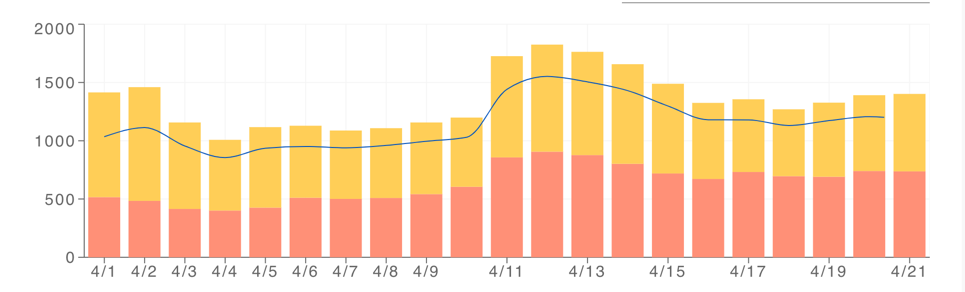
Field note: traffic stays even because new users keep joining every day while existing users keep coming back. A check-in campaign’s real value isn’t a single-day spike—it’s sustained traction across the whole run. Measure success by total return visits and cumulative DAU, not the burst of traffic on day one.
Check-in mini-glossary
An instant reward you get each time you complete that day’s check-in.
A staged reward unlocked once you hit a set number of cumulative check-in days (say, 3 or 7).
Feversocial offers multiple game modes so brands can run their own draw formats (like the Lucky Wheel or an online Scratch Card), or send rewards directly—member points, discount coupons, and more.
Breaks a long check-in run into short-cycle goals (like 3-day and 7-day tiers) so users land a meaningful reward every few days, lowering the barrier to keep going.
Four design keys for a check-in campaign
A check-in campaign uses reward design to trigger consumer psychology and drive return visits. Here are four dimensions, each matched against Feversocial’s real performance data and behavioral psychology research:
Check-in reward: a reward every day builds baseline motivation
For brands, giving out a reward every single day is the hardest design problem. Rewards usually take one of three forms: member points, discount coupons, or a prize draw. From the consumer’s side, the most tangible reward is getting something of real value for free—effort in, value out. Member points are a good example: Feversocial found that campaigns giving 1 point per check-in kept 80% of participants returning on day 2, and 75% still returning on day 3.
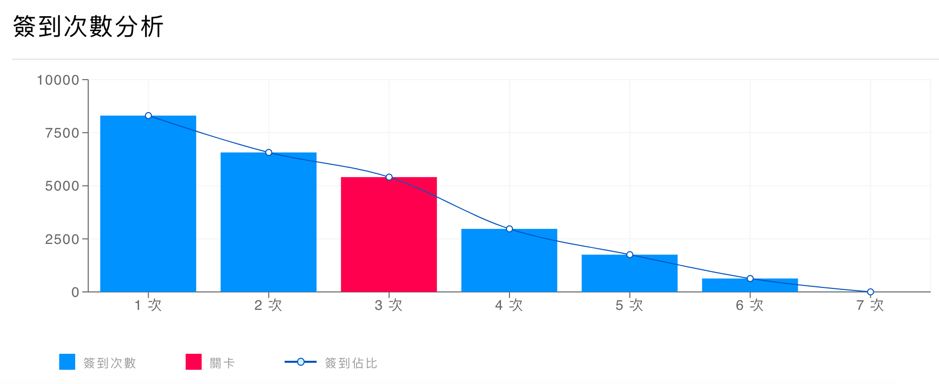
No points system? A prize draw works too: a campaign giving away a daily free-shipping voucher draw still drove 50% return visits on day 3.
Milestone reward: the key driver of return visits—and the most dangerous drop-off point
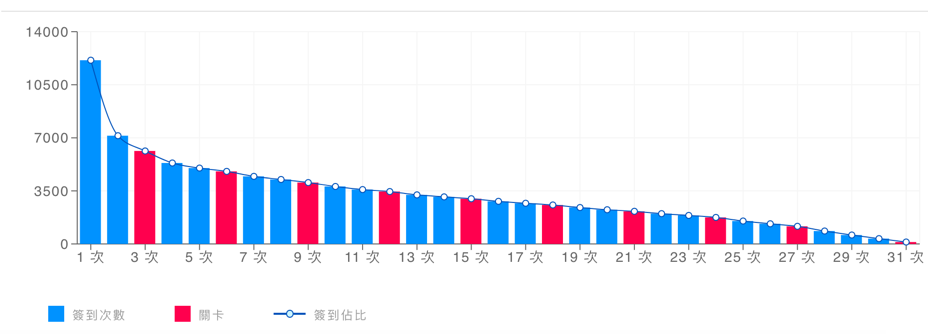
Designing the milestone reward well is critical to keeping participants coming back. Even without a check-in reward, Feversocial found that a strong milestone reward alone can drive 50% of participants to reach the first milestone. Kivetz, Urminsky, and Zheng (2006, Journal of Marketing Research) analyzed 949 completed loyalty punch cards and found that customers visit more frequently as they near the target reward—the time between visits from the first stamp to the last shrank by about 20% (the goal-gradient hypothesis). The milestone reward taps exactly this effect to push 50% of users toward the first milestone.
The fix: three ways to remove the post-reward cliff. The moment a milestone reward is granted, the next stage of progress must appear on screen immediately—don’t wait until the next day’s push notification, because by then the user is already gone:
- Multi-stage progressive milestones: design 3-day and 7-day tiers, and show “X days until your next milestone” the instant a tier is claimed.
- Head-start progress after claiming: automatically grant a starting head start on the next stage the moment a reward is claimed.
- Turn the milestone reward into an entry ticket: completing 7 days of check-ins unlocks eligibility for an exclusive VIP Lucky Wheel draw.
Check-in day design: you don’t have to start at zero, and milestones should stay short
In practice, a check-in run that’s too long wears consumers out. Interest typically peaks in the first 3 days, and milestones set past 10 days see return rates fall to 10–20%. This is about the milestone’s check-in day count, not the campaign’s total run—your campaign can run for a month while the milestone stays at 7 days, so users who join partway through still have time to complete it.
Reward design: quality over quantity, and who gets it matters more than what it is
With a limited budget, most brands try to get more people a reward by raising the reward count and lowering each one’s value. But Feversocial’s data shows the art of reward-giving is quality, not quantity—a high-value or rare reward actually motivates more. Rewards also need to fit the target audience: a reward your audience doesn’t actually want, or one that only exists to move a cross-promotion partner’s giveaway stock, rarely drives return visits. Some campaigns hide what the reward actually is on the campaign page because its value is low—but in practice, once a consumer gets an unremarkable reward the first time, they won’t come back for a second.
4 years running: how fresh-grocery retailer Cotton Field gamified its app
Cotton Field Organic Life, with more than 300,000 members, has run gamified in-app campaigns (Lucky Wheel, Scratch Card, Prize Shower, Poke a Prize) during its Lunar New Year sale for 4 years running. What does that kind of stickiness actually look like?
200K+
campaign participants in a single year
97%
conversion rate for direct in-app participation with no login
90%+
in-store voucher redemption rate
1. A 97% conversion rate comes from removing login friction
Feversocial’s game modules integrate seamlessly with single sign-on (SSO) in the Cotton Field app, so members tapping a campaign banner land on the game page already logged in—no re-entering credentials. With that friction fully removed, nearly every member who saw the campaign took part.
2. A 90%+ in-store voucher redemption rate shows the reward actually drove offline redemption
The campaign issued unique codes tied to the in-store POS system, so members had to physically visit a store to redeem them. Online gamified engagement successfully drove offline, in-store spending—the clearest proof that lifting your open rate needs a next step.
3. Four straight years is the real stickiness metric
Participation numbers for any single campaign look good on their own, but a mechanic that the same member base keeps embracing enthusiastically for 4 years running shows gamified engagement has become part of the brand’s annual marketing rhythm—a ritual members look forward to, not a one-off traffic push.
Older audiences play along just fine: Cotton Field’s member base skews older, and “our customers are too old for games” is a common worry. This case proves that as long as the entry barrier is low enough—SSO with no login, simple and intuitive rules—an older audience can drive a participation conversion rate as high as 97%.
What’s different about running these mechanics in an app versus on the web?
The design principles behind gamification are the same across web, LINE, and apps—but four things play out completely differently once you implement them in a brand’s app:
Entry friction has to hit zero (single sign-on)
A web page can get away with asking users to fill out a form once—an app can’t. Members are already logged into the app, so if the campaign page asks them to re-enter their credentials, you’ll lose more than half of that day’s traffic on the spot. In-app campaign pages need to auto-complete SSO through encrypted webview parameters. Cotton Field’s 97% conversion rate is what happens when you get this right.
Rewards must post automatically to the app account (API/webhook integration)
Win something on a web page and consumers ask, “Where’s my coupon?” Win something in an app, and users expect the reward to show up immediately in their coupon wallet or points balance. If a reward doesn’t post in real time, the campaign is just a web page bolted onto the app, not part of the app’s own service experience.
Push notifications should remind, not nag
The push copy that pairs best with a check-in campaign is “Your 5-day check-in reward expires in 3 hours!”—not “Come join our check-in campaign.” The first triggers loss aversion around protecting existing progress; the second just asks users to do one more new thing.
The campaign page can’t stop at the game—it needs a commercial next step
Paschmann et al. (2025, Journal of Marketing Research) tracked 18,952 app users over a year and found a gamification side effect: once users claim a game reward, engagement that actually drives commercial value declines if there’s no smooth path into a purchase. Gamification can bring users back to the app, but if all they can do once inside is play, brands end up cultivating bounty hunters, not customers. The results page after a game must connect seamlessly to product recommendations, in-store vouchers, or member benefits.
Avoid these traps: 3 blind spots that break in-app retention mechanics
Users churn right after claiming the reward, and research confirms 17% of drop-off happens the moment a reward is claimed. Milestones need to progress in stages (like 3-day and 7-day tiers), with the next stage’s progress showing on the redemption screen itself.
Forcing users to check in 30 days straight is such a high bar that one missed day easily leads to giving up entirely. Short 3–7 day tiered goals keep participation persistence high.
Keeping users coming back hinges on incentive design. The most common failure comes down to missing two things:
- Small daily incentives: give a low-barrier, small reward every day (daily points, micro-prizes) to keep the habit and motivation to open the app alive.
- Clear milestone goals: milestone rewards and cumulative thresholds need to be explicit (clearly visible 3-day and 7-day tiers, for example) so users always know exactly what their effort earns—and have a predictable goal to work toward.
Frequently asked questions
Our app’s open rate is low—where should the marketing team start?+
How many days should a check-in campaign run?+
What’s the most effective daily reward?+
How do we stop members from quitting after missing a check-in?+
How do we prevent churn right after a milestone reward is claimed?+
Our audience skews older—will they even engage with gamification?+
Does embedding these gamified modules require major changes to our app’s architecture?+
We don’t have an app yet, only a LINE official account—can we still run these mechanics?+
Turn a reason to open into a daily habit
Feversocial’s modular tools drop straight into product launches, store openings, or seasonal sales like 618, Double 11, and anniversary campaigns—giving your app and LINE official account a steady stream of daily active traffic.
More e-commerce member engagement case studies
More success stories
