Human-centered AI marketing automation: an Always-On strategy for driving more conversions
How to maximize your ROI across the customer lifecycle
AI is accelerating post-pandemic digital transformation—has your marketing strategy kept up? Marketing can no longer run on manual, campaign-by-campaign bursts; it needs an Always-On mindset.
By the time consumers decide to buy, they’ve already done their research online—how do you reach them one step earlier?Future competition won’t be about price or product—it will be about customer experience.
2026 digital marketing trends
Marketing can’t run in bursts anymore—it needs an Always-On mindset
Google introduced the concept of “micro-moments” in marketing—today’s consumers check their phones every few minutes, and their online time is fragmented into countless small moments. Whether they want to chat, learn something, decide where to go, buy something, or get something done, they simply pick up their phone. Research shows consumers are visiting physical retail stores less often and spending less time on shopping sites too, because by the time they land on one, they usually already know what they want to buy and check out right away.
So, successful brands need to capture these micro-moments across the customer lifecycle, and when a prospect starts their buying journey, give them the real-time information or service they need.
Marketing now drives business decisions and revenue
As new technology keeps emerging, digital marketing tactics keep changing with it. Smartphones have transformed consumer behavior, and the rise of chatbots has shifted conversations from brand pages to Facebook Messenger and LINE. The continued evolution of AI, VR/AR, big data, Web3, and blockchain will keep reshaping where marketing goes next.
Many companies have elevated digital marketing to a strategic, company-wide priority—because only brands that keep pace with the latest trends can win a share of consumers’ wallets.

Focusing only on ad ROI is outdated—evaluating customer lifetime value is what wins
-Matt Lawson, Marketing Director, Performance Ads at GoogleFuture competition won’t be about price or product—it will be about customer experience
We’re in an age of product abundance, and an endless catalog is no longer enough to satisfy consumers. As online shopping becomes the norm, brands need to examine every digital touchpoint with their customers—their role on social media, the experience on their website, whether their content earns trust, and how they handle customer service on LINE or Messenger. Brands will need to collect and unify richer customer data to power more personalized experiences.
Digital technology keeps evolving, and we believe successful brands need to master where these five key technologies are headed:
Efficient, experience-driven marketing execution is what determines your competitive edge ...
No-code web app technology for marketing
No-code web apps let you build and launch applications without any coding knowledge. They’re simple enough for marketers to use directly, without waiting on IT—Feversocial’s OCEP marketing platform is a great example ;-) No-code web apps have reshaped the marketing industry in a few key ways:
Higher marketing efficiency and impact: No-code web apps help brands build and launch websites, mobile apps, CRM systems, and more—faster—driving more efficient, more effective marketing.
Faster marketing data analysis: No-code web apps help brands collect, analyze, and act on data faster to optimize marketing strategy and planning—while also giving brands a clearer read on consumer needs and behavior, so they can build more targeted, more effective campaigns.
Lower marketing cost and risk: No-code web apps reduce the cost and risk of building and launching applications, while boosting marketing efficiency and effectiveness—making brands more competitive and more sustainable.
It’s worth noting that no-code technology has moved well beyond standalone campaign pages. In today’s app marketing practice, more and more brands embed these lightweight web-app interactive modules directly in-app—no engineering roadmap or release cycle required—so they can quickly test check-ins, giveaways, and habit-building campaigns while cutting the cost of running and maintaining the app.
👉 Go deeper: want to apply these interactive mechanics to boost retention in your own app? Read the full guide: App marketing strategy: using gamification to lift retention and DAU.
Interactive and experiential content
Interactive and experiential content is gaining ground across entertainment and marketing alike, and it’s becoming a major trend in digital marketing. This content format helps brands capture attention, deepen consumer engagement, and build both visibility and loyalty. Here are a few examples:
Gamification elements
Gamification elements can dramatically improve the app experience, boosting engagement and stickiness. Beyond fitness apps using badges to drive goal completion, e-commerce and retail brands increasingly use daily check-ins, points-based prize draws, and member achievements to lift activity and repeat purchases.
🔗 Designing app gamification for retentionSocial referral power
Tap into the power of social referrals: reward consumers for inviting friends to play, and watch brand visibility and awareness grow. A brand might build a simple game where a customer invites friends to join—if a friend plays and wins a reward, the referring customer earns a bonus reward too.
AR/VR experiences
Augmented reality (AR) and virtual reality (VR) are already widely used across industries, and they’re set to become a major digital marketing trend too. AR and VR let consumers experience products and services more fully, lifting satisfaction and conversion. Some e-commerce platforms, for example, use AR to let shoppers virtually try on clothes or jewelry online, helping them make better purchase decisions.
Build a first-party data platform (CDP) and unify your engagement channels
In markets with slowing population growth, driving repeat purchases and referrals is the only reliable way to protect revenue. Building your own customer data platform and communication channels helps brands achieve the following:
CDP collects and organizes consumer data, then segments audiences by need and behavior—so brands can build more personalized marketing strategies that lift conversion and loyalty.
CDP unifies data from multiple sources—website activity, social media, SMS and email, mobile app data, and more—so brands can run omnichannel marketing and sales campaigns that build visibility and awareness.
CDP gathers and organizes consumer data so brands understand needs and behavior and deliver better service. For example, when a customer reaches out, CDP can automatically recognize their identity and history, and surface the right support and solutions—boosting satisfaction and loyalty.
AI and machine learning make 1:1 personalized marketing possible ..
Gen AI and agentic AI unlock Always-On personal service
If you’ve ever talked to a bot, you probably walked away thinking it was pretty dumb—nowhere close to replacing a real support rep. That’s because most chatbots today run on reply logic engineers hand-coded to stand in for human answers. Even now, the most common use case is still guided interactions: completing a task under pre-built logic, or sending timely reminders—not actually holding a conversation.
Then ChatGPT arrived out of nowhere in late 2022 and truly opened the door to 1:1 marketing. Built on natural language processing (NLP) and deep learning, ChatGPT can hold an intelligent conversation with customers by voice or text, answer their questions, and offer tailored recommendations. Connect ChatGPT to a brand’s own systems and data, and it can power personalized notifications, content services, and specific tasks.
Built on OpenAI’s technology, natural-language Q&A search has the potential to challenge Google’s dominance as the search engine leader. Brands need to watch this space closely and understand what it could mean for their own search traffic.
AI marketing automation creates more sales opportunities
The diagram below maps a brand’s relationship with a customer—from first contact to post-purchase—commonly known as the customer lifecycle or customer journey. Let’s call this customer Alex, and the brand FeverBrand Appliances. Along Alex’s own buying journey, the brand has countless opportunities to connect with him.
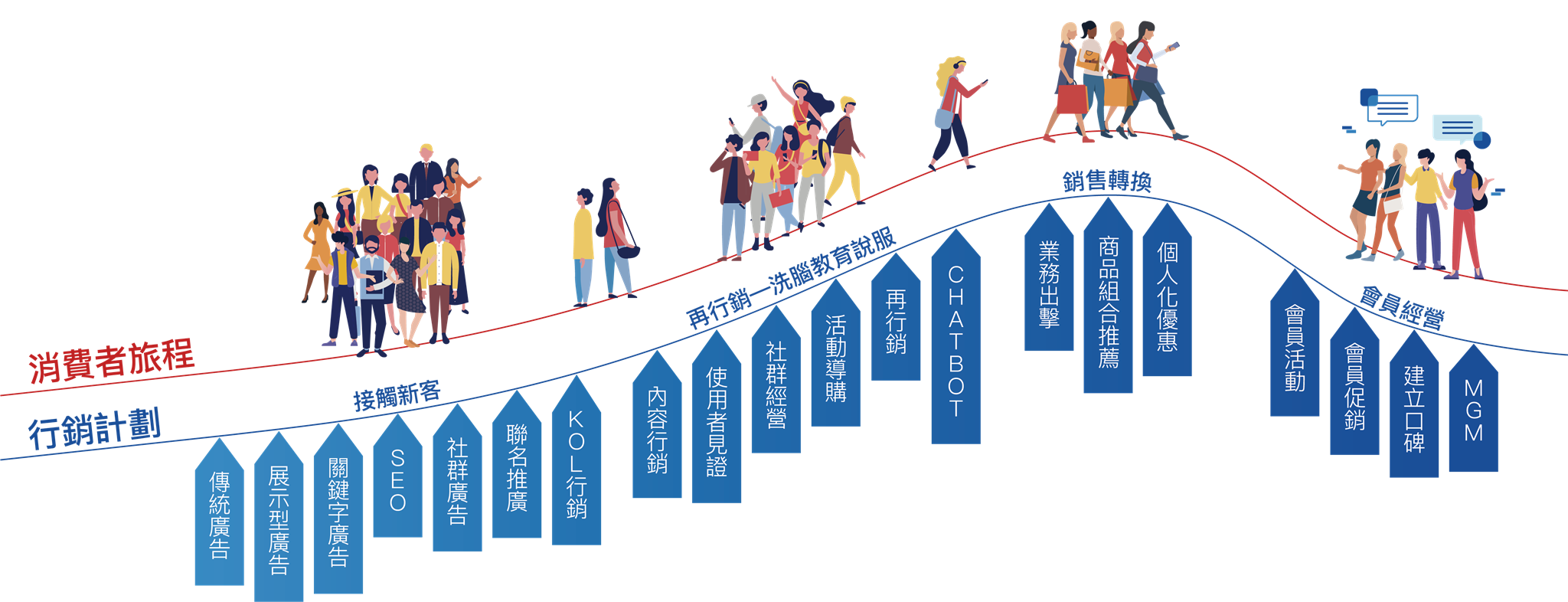
Alex loves brewing his own coffee and wants to buy a grinder. He starts by searching for brands and specs on the market, quickly digs through online forums, and discovers that a domestically made FeverBrand grinder offers great value. He then visits FeverBrand Appliances’ website to compare models, but isn’t ready to decide, so he leaves the site.
The next day, Alex sees an article about coffee-grinding techniques on Facebook—it’s actually an automated retargeting ad FeverBrand Appliances placed using first-party browser cookie tracking from its website, aimed at recapturing Alex’s interest. Alex clicks through to the Facebook page and spots a chatbot giveaway for an upcoming grinder model, so he enters on the spot.
A week later, Alex receives an eDM from FeverBrand Appliances featuring cafes that use its grinders, suggesting he visit one to see the grinder in action. A month later, during an anniversary sale, he finally buys the FeverBrand grinder through a price-comparison site on his go-to shopping site. After unboxing it, Alex spots a QR code on the machine inviting him to join FeverBrand Appliances’ LINE Official Account to complete product warranty registration, unlocking a 20% discount on accessories going forward. Inside the LINE Official Account, FeverBrand Appliances built a getting-started challenge that walks Alex through gamified onboarding, helping him get comfortable with his new grinder and brew a range of coffee drinks.
Three months later, FeverBrand Appliances manages the relationship through a CDP-driven automated journey, using chatbot push messages on its LINE Official Account to handle after-sales service, invite Alex to complete a satisfaction survey, and recommend other related appliances—setting up the next purchase.
Six months later, based on Alex’s ongoing engagement with the brand, FeverBrand Appliances determines he’s a fan and invites him to join its MGM referral program—sharing his experience with friends shopping for a grinder, so anyone he refers gets an exclusive coupon.
Every one of these touchpoints is something AI marketing automation can power.
When technology moves this fast, marketers win by staying flexible
These technologies feel like they’ve already arrived—yet somehow still not fully practical?
So what should you do right now?
- Audit your marketing strategy against the full customer lifecycle
- Aggregate sales and support feedback to understand customer needs and build better digital service
- Run UGC (user-generated content) campaigns to grow your online and social influence and build trust
- Learn how AI technology can be applied to your services to boost efficiency and quality
- Prepare for marketing automation: start collecting the data you need and adopt a system like CDP that unifies customer data
Your digital marketing strategy needs to adapt quickly to a changing environment. There’s no shortage of tools out there—with the right marketing mindset, a data-driven approach, and the know-how to put those tools to work, you can move faster than your competitors.
Ready for 2026?
Bring your Always-On strategy to life with Feversocial’s marketing toolkit
